
 Economic uncertainty, shifting tax policies, and fluctuating donor confidence can make traditional fundraising feel like navigating a storm without a compass. For nonprofit development professionals, relying solely on cash donations or online fundraisers during these periods often results in unpredictable revenue and budget shortfalls.
However, changing markets also present unique opportunities for organizations willing to adapt their strategies. By expanding the ways supporters can give and leveraging adaptable technology, your development team can build a more resilient financial foundation for your mission. Read on to discover three helpful strategies to fortify your fundraising efforts against market shifts!
1. Pivot to Non-Cash and Tax-Smart Giving Options
During economic turbulence or inflationary periods, donors often hesitate to part with their cash on hand, fearing they may need it for immediate expenses.
That’s why your nonprofit should educate donors on alternative, tax-advantaged giving methods. These options allow supporters to give from their accumulated wealth rather than their disposable income, transforming a hesitant donor into a major contributor. Here are some of the most popular non-cash giving options:
Donor-Advised Funds (DAFs)
Think of a DAF like a charitable giving account. Here’s how this fundraising method works:
- Donors make a contribution to the fund and receive an immediate tax deduction.
- The sponsoring organization (like Fidelity or Schwab) invests and grows the funds.
- Donors recommend grants to eligible nonprofits over time.
FreeWill’s DAF research found that there are currently 3.6 million DAF accounts nationwide, collectively holding more than $326 billion. However, nonprofits commonly encounter a few roadblocks with DAF grants: they fail to make them a clear option, can’t identify DAF donors, worry that those supporters will give anonymously (making stewardship difficult), or wait until year-end to ask for them.
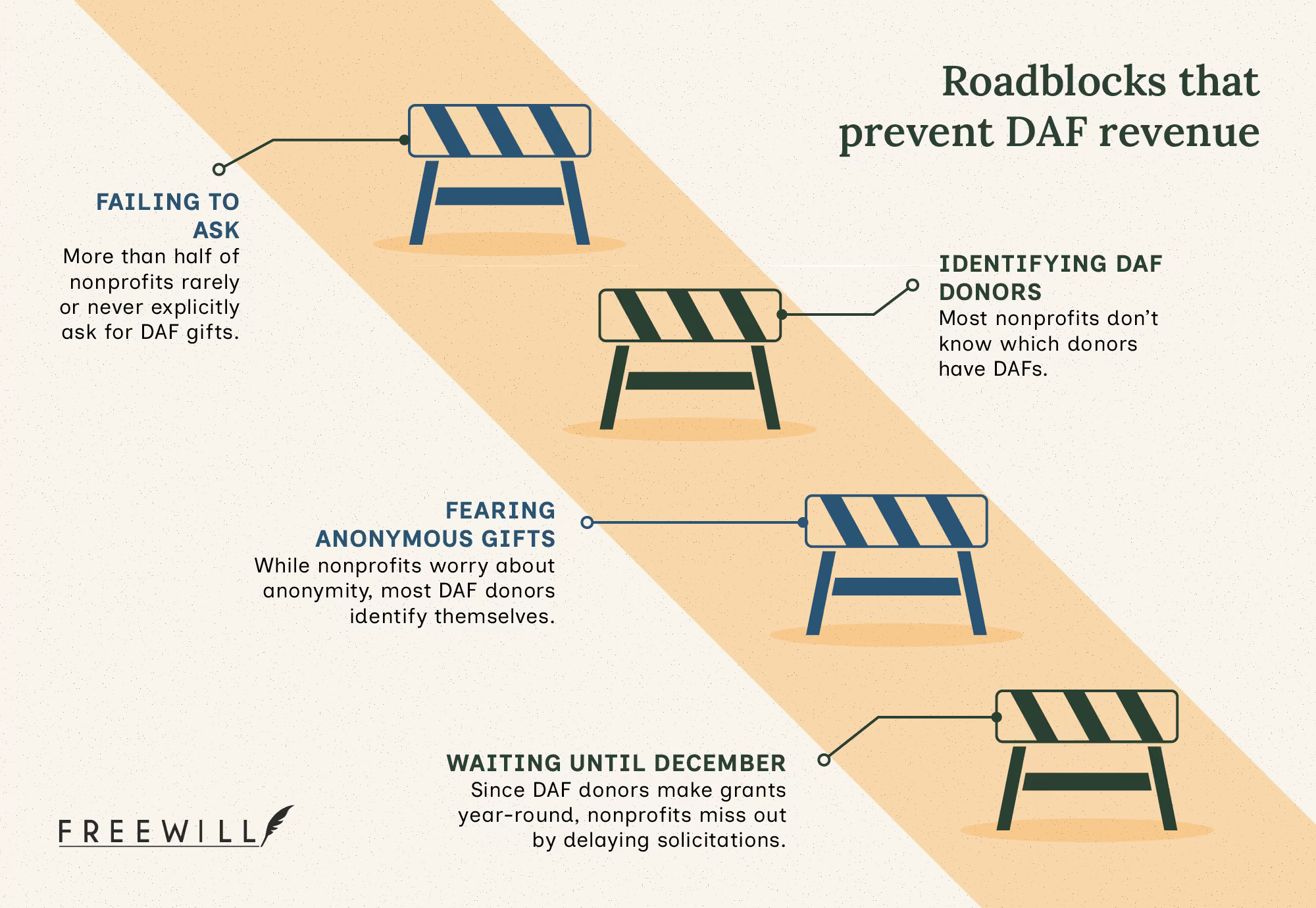
However, promotion throughout the whole year helps immensely. Plus, software makes the challenges of donor identification and anonymity obsolete by proactively capturing donor details and enabling automated thank-you messages for those who choose to remain anonymous.
Stocks and Securities
Accepting stock donations enables your donors to give appreciated assets directly, which maximizes their impact. Giving stocks held for over a year allows your supporters to avoid capital gains taxes they would otherwise owe if they sold the assets first, while still claiming a fair market value tax deduction.
With a stock giving tool, you can outsource the heavy lifting to your technology. This type of tool will instantly deliver transfer instructions to the donor, issue an IRS-compliant tax receipt, and liquidate gifts of stock.
Qualified Charitable Distributions (QCDs)
Provide a highly tax-efficient vehicle for your older supporters by accepting QCDs. For donors aged 70.5 or older, a QCD allows a direct transfer of funds from their individual retirement account (IRA) to your nonprofit. They’re able to avoid income tax on the distribution while counting toward their required minimum distribution (RMD), which kicks in when they turn 73.
Cryptocurrency
Start accepting cryptocurrency to engage younger, tech-savvy donors who hold high-growth digital assets like Bitcoin and Ethereum. Donating crypto directly is treated as a non-cash charitable contribution, allowing donors to eliminate capital gains tax while deducting the full fair market value on their taxes. Similar to stock, if someone sold a crypto holding to donate cash, they’d pay capital gains tax, reducing their total contribution to your nonprofit.
To accept crypto donations, your nonprofit needs to invest in specialized tools for converting these assets. We recommend going with a unified non-cash giving platform that allows you to accept a variety of complex assets (like crypto, stocks, DAFs, and QCDs) in one place. For crypto specifically, this type of platform will convert the cryptocurrency donations and automate compliance, donor acknowledgment, and tax receipting.
In-Kind Goods and Services
Beyond these tax-advantaged options, consider accepting in-kind donations as well. Donors can give goods that support your work (e.g., office equipment, supplies for beneficiaries) and services (e.g., pro bono legal services, web development support). To spark inspiration and ensure your nonprofit receives helpful contributions, publish a wishlist of acceptable items on your website.
Takeaway: By diversifying the types of assets your organization accepts, you create a reliable safety net that protects your revenue goals when liquid cash is tight. Proactively marketing these options on your digital donation forms ensures donors know they have flexible, financially savvy ways to support your mission, regardless of the broader economic climate.
2. Anchor Long-Term Stability With Planned Giving
Market shifts highlight the danger of relying purely on short-term fundraising cycles. To insulate your nonprofit against economic turbulence, your team should prioritize planned giving as the ultimate key to long-term sustainability.
Bequests are the most popular option. To create one, a donor needs to name your nonprofit as a beneficiary in their will. It’s a great way to leave a lasting legacy on a cause they care about.
While legacy gifts materialize in the future, establishing the pipeline today provides your organization with a dependable baseline for the years to come. Nonprofits with legacy giving programs can tap into the Great Wealth Transfer as trillions of dollars pass from older generations to younger ones. Plus, when a donor includes your nonprofit in their estate plan and your nonprofit actively stewards them, their annual cash giving to your organization typically increases.
Think of it this way: a planned giving program anchors your organization through decades of potential economic shifts. Securing these future commitments gives your nonprofit the financial confidence and stability needed to plan ambitious, long-term programmatic goals.
3. Adopt An Agile, Tech-Enabled Grant Strategy
In unpredictable markets—especially those facing federal funding freezes, shifting corporate budgets, or delayed foundation grants—don’t make the mistake of pausing institutional fundraising efforts.
Implementing an agile, tech-enabled strategy helps you weather funding shifts and capitalize on new opportunities the moment they arise. Here are some tips for a more proactive grant strategy that can weather economic shifts:
- Sustain a diversified pipeline. The purpose of keeping your grant-seeking active during economic downturns is to avoid dangerous funding gaps. Continuously pursue diverse foundation and government grant opportunities to mitigate the risk of cuts in any single area.
- Automate prospecting and drafting. Specialized AI tools can boost your team’s speed and efficiency. These platforms might match you with grant opportunities and draft tailored proposals, helping your team quickly submit high-quality applications that align with funder expectations. Grant Assistant recommends looking for AI writing software that is trained on nonprofit data, has strong privacy protocols, and offers collaboration tools for multi-user editing.
- Centralize data with collaborative software. By using cloud-based modern grant management software, your team can build an accessible internal knowledge base, track reporting deadlines, and eliminate version control issues when writing complex proposals.
By integrating advanced prospect research databases, AI-driven writing assistants, and collaborative project management software into your daily operations, you transform your grant strategy from reactive to proactive. Adopting the right technology ensures your funding pipeline remains full even in turbulent times.
Looking Forward
Navigating a changing economic landscape requires your development team to be both proactive and adaptable. Embracing non-cash gifts, securing legacy commitments, and streamlining grant processes will ensure your nonprofit thrives regardless of market conditions.
As a next step, write down your nonprofit’s fundraising streams. Do you have plenty of options aside from annual donations and fundraising events? If not, talk with your team about which giving options would work best for your nonprofit and its donors, and decide what specialized technology you’ll need to make it happen.
About the Author
 Patrick Schmitt, Co-CEO of FreeWill
Patrick Schmitt and co-CEO Jenny Xia founded FreeWill at Stanford University’s Graduate School of Business in 2016. FreeWill’s charitable giving platform makes it easier for nonprofit fundraising teams to unlock transformational gifts, and to date has generated over $6.6 billion in new gift commitments for thousands of nonprofit organizations. Patrick hosts FreeWill’s popular webinar series, educating thousands of nonprofit fundraising professionals each month about planned and non-cash giving strategies.
Before FreeWill, Patrick was the Head of Innovation at Change.org, where he helped grow the organization to 100 million users in four years. Prior to that, he ran email marketing for President Obama and served as Campaign Director for MoveOn.org.