
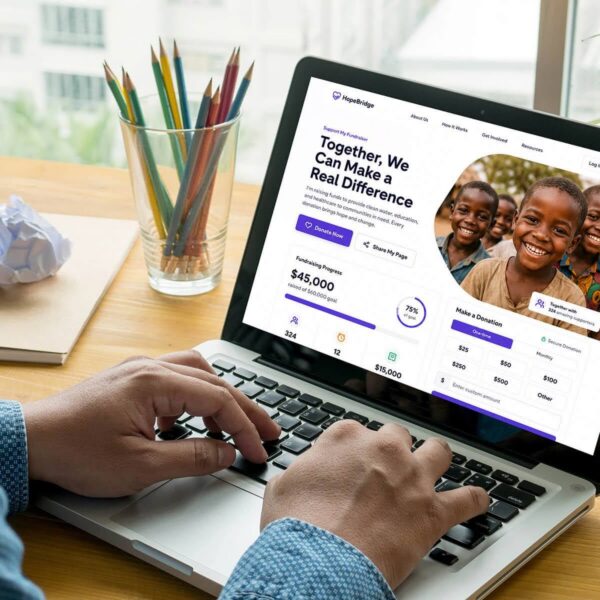
 Peer-to-peer fundraising has cracked open the fundraising landscape for nonprofits. While traditional fundraising campaigns rely entirely on your organization’s direct reach, peer-to-peer fundraising enables you to recruit volunteers to fundraise on your behalf. This enables you to reach more potential donors and capture more contributions, helping you achieve your fundraising goals faster.
That said, many nonprofits often encounter friction when trying to scale these peer-to-peer fundraising efforts. In addition to selecting the right peer-to-peer platform to streamline backend management, you should also ensure that the public-facing pages themselves are meticulously designed to appeal to prospective donors.
In this article, we’ll break down the anatomy of a peer-to-peer fundraising page that actually converts visitors into donors, and we’ll also provide actionable design tips that can help you optimize these pages.
1. The Volunteer’s Personal Story
The success of a peer-to-peer campaign rests on your volunteers, making them the indisputable heroes of your fundraising pages. While standard organization pages provide a broad overview of your work, your peer-to-peer pages must establish an immediate, human connection to drive action.
For that reason, the volunteer’s personal story should be front and center on your page. This story should showcase how they relate to your nonprofit, including how they first came across your organization, what their experience was donating or volunteering for you, and why they are so passionate about your cause. The more honest and personal the story is, the better.
This section of the page should also include high-quality images and short videos of the volunteer in action. This helps prospective donors see how the volunteer is connected to your organization, making it easier for them to trust you. And when they trust you, they’ll be more likely to contribute to your fundraiser.
2. Your Campaign and the Mission
Once the visitor connects with your volunteer’s personal narrative, the page must smoothly transition to highlighting your nonprofit’s overarching mission. This section grounds the volunteer’s passion in concrete organizational goals and demonstrates exactly what the funds will accomplish.
We recommend including the following details in this section:
- The name of the fundraising campaign and its purpose
- General details about your nonprofit’s mission
- A link to your nonprofit website
- A link to join the peer-to-peer fundraising campaign and create their own fundraising page
It’s also a good idea to proactively address common myths that can hinder donor trust. For example, some potential donors may mistakenly believe that peer-to-peer fundraising is spammy or impersonal. You can refute this by emphasizing that peer-to-peer fundraising is actually driven by authentic, personal relationships. When donors understand that a friend is championing your mission out of genuine passion, the request feels less like a solicitation and more like an invitation to join a community of support.
3. Built-In Donation Form
The ultimate goal of a peer-to-peer page is to secure a contribution, which means the donation process itself must be as seamless as possible. Any friction during checkout can cause a highly motivated supporter to abandon their gift.
That’s why you need to embed the donation form directly on the page. If your donors have to click away to a separate donation page, it disrupts the donor journey, and they may end up not donating at all.
When designing the donation form, ensure it is intuitive, fast-loading, and easy to use for all demographics. Webpage accessibility is absolutely essential as it makes the donation process smooth and hassle-free for everyone, especially older donors or people with disabilities. Some ways to make your peer-to-peer page accessible include adding alt text to images, using high color contrast between the background and foreground elements, and ensuring that buttons are large enough for visitors to read.
Another way to improve the donation experience is to offer digital wallet options such as Apple Pay or Google Pay. Offering these accelerated payment methods enhances the mobile experience and drastically reduces the time required to finalize a donation.
4. Real-Time Fundraising Updates
Adding real-time updates to your page creates a sense of urgency for visitors, inspiring them to contribute to help you reach your goal. And when they see the bar move after their donation, they’ll get a dopamine rush from knowing they’ve done something good.
Another great idea for your peer-to-peer fundraising strategy is to display a rolling list of recent donations. Doing so provides social proof, showing visitors that others are actively participating. You can even take this a step further by enabling an activity ticker that highlights milestones, such as a volunteer reaching halfway to their goal. Celebrating these micro-wins keeps the page feeling active and dynamic.
5. Social Media Buttons
Shareability is the engine that drives all types of fundraising campaigns, but especially peer-to-peer fundraising. These campaigns rely heavily on organic reach, but they will only gain traction if amplifying the message is effortless for the user.
That’s why you should embed social media buttons on your page. They can be either at the top or bottom of the page; just make sure they’re big enough to capture your visitor’s attention.
We also recommend providing pre-written suggested text and campaign hashtags when a user clicks the share button, so they don’t have to think of what to say and can just share the page in just a few clicks.
Additionally, you may want to include a highly visible copy link button alongside traditional social icons. Many supporters prefer to share via direct text message or email with close friends, and a one-click function makes this private sharing seamless.
Additional Tips for Designing a Peer-to-Peer Fundraising Page
Beyond the core components, the overall user experience and visual layout play a massive role in converting traffic into revenue. Attention to aesthetic and structural details can separate an average campaign from a highly successful one.
According to Kanopi Studios’ guide to nonprofit website design, you should also keep these design tips in mind when building your peer-to-peer pages:
- Ensure the page has a clear visual hierarchy that guides the reader’s eye naturally from the story to the donation form.
- Make your donation call to action clear, punchy, and impossible to miss.
- Maintain consistent, aesthetically pleasing visual branding that aligns with your main organization.
- Check that the page is optimized for fast loading speeds across all devices. Also, check that the page works well on mobile devices.
- Guarantee a logical structure that makes the page easy to navigate without overwhelming the visitor.
Consider conducting regular A/B testing on elements like button colors or header images. Small, data-informed tweaks to the page’s design can yield significant improvements in your overall conversion rates over time.
Peer-to-peer fundraising remains a highly viable and lucrative strategy, bringing in vital revenue while organically spreading your mission to a wider audience. That said, keep in mind that no matter how compelling the personal story or campaign mission may be, the underlying technical build and design of the peer-to-peer page ultimately determine its success. So, you should invest time in thoughtfully structuring these pages, and your volunteers will have the tools they need to thrive.
About the Author:
 Anne Stefanyk is the Founder and CEO of Kanopi Studios, a leading digital agency that designs and builds websites for mission-driven organizations. With deep expertise in strategy, user experience, and open-source technologies, Anne has guided Kanopi to become a trusted partner to nonprofits, higher education, and healthcare institutions.
Since launching Kanopi in 2010, Anne has fostered a people-first culture and a strong commitment to accessible, sustainable web practices. Her team creates inclusive digital experiences that help organizations make meaningful impact.